
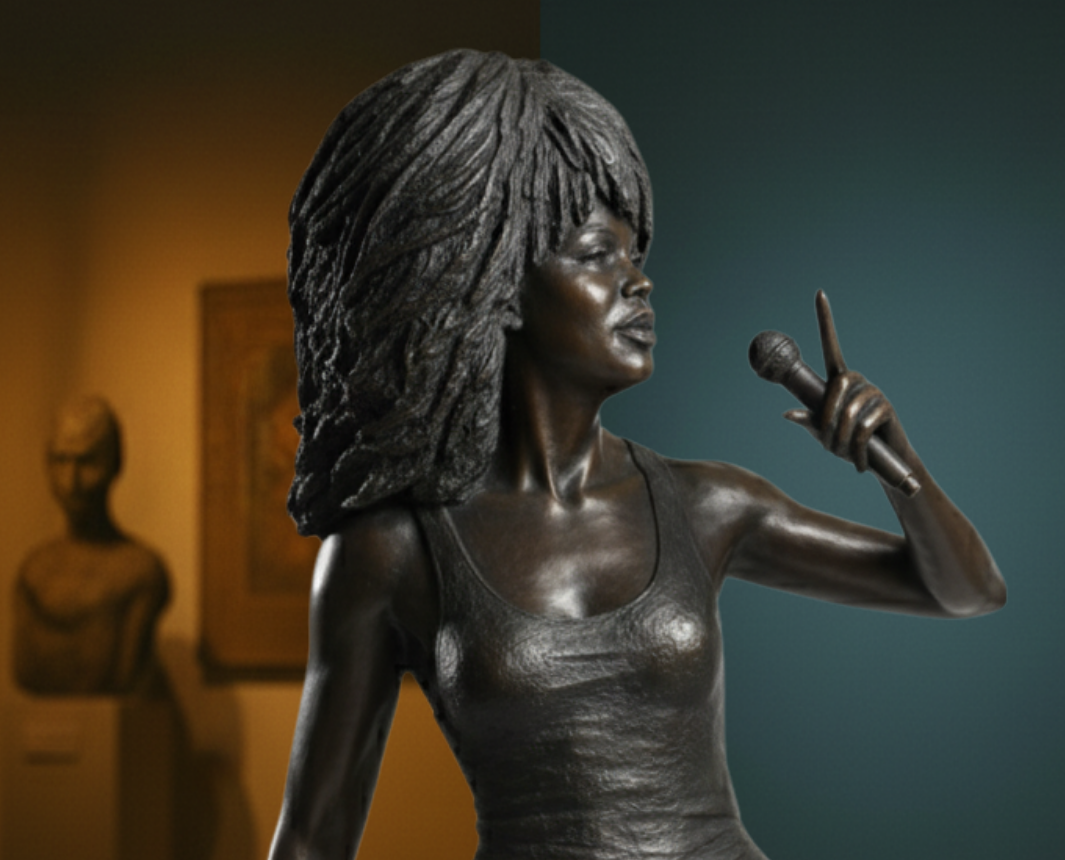
When a tribute misses the mark, it distorts more than just the art — it distorts the legacy.
By: Beautiful Truth | Culture Check | October 9, 2025
Source Acknowledgment: This commentary draws from reporting by The U.S. Sun and archives from the Roswell Arts Fund and Fulton County Arts & Culture.
TODAY’S TRUTH
SUMMARY
When Tina Turner’s statue was unveiled in Brownsville, Tennessee, the backlash was immediate. Fans called it hideous, insulting, even a hate crime. But before we just chalk this up to bad art, let’s talk about the man behind the statue — Fred Ajanogha.
Ajanogha is a Nigerian-born sculptor whose work can be found throughout Georgia. In Roswell, he created a cast stone sculpture of interwoven fish, meant to symbolize unity and sustenance. In Atlanta, his bronze portraits are displayed at the airport, and in Macon, he sculpted a piece honoring Harriet Tubman. His work leans on symbolism and stylization — but here’s the truth: symbolism doesn’t always translate. And when it comes to Black American icons, the disconnect can feel like erasure.
Because Ajanogha isn’t just an artist. He’s an outsider. Nigerian by heritage, working in American public spaces, commissioned to capture legacies that aren’t his to carry. And that’s where the problem begins.
Foundational Black Americans struggle — the forced labor, the stolen generations, the fight for civil rights, the cultural survival through centuries of terror — isn’t something you can study in a book and then carve into stone. It’s a lineage. It’s lived memory. And too often, outsiders are chosen to interpret our pain, while voices from the lineage itself are sidelined.
The Disconnect in Roswell
We’ve already seen how his symbolism gets lost in translation — and nowhere is that clearer than in Roswell. Roswell itself tells a different story. The city markets its antebellum mansions like Barrington Hall and Bulloch Hall as tourist attractions, centering wealthy White families while minimizing the enslaved black labor that built those estates.
Black history in Roswell still lives — in cemeteries, in churches like Zion Missionary Baptist, and in neighborhoods like Macedonia and Stumptown — yet it remains overshadowed by a carefully packaged Southern charm.
So when Roswell installed his fish sculpture, it felt hollow. How can a community embrace symbols of togetherness while still dodging the truth of its foundations? That’s the same danger we see now: outsiders flattening our legacies, turning lived struggle into abstract art.
The Myth of Representation
Cities love to call it representation. They unveil statues and murals, throw around words like inclusion, and call it progress. But if the power to tell our story still belongs to someone else, it’s not representation — it’s repetition.
Outsiders keep being chosen to depict our pain because institutions are more comfortable with us being honored than in control. They want our images, not our input. That’s the quiet truth.
Cultural Knowledge vs. Lived Experience
There’s a difference between understanding a symbol and carrying its meaning.
Fred Ajanogha’s roots are Nigerian — his art reflects African spiritual concepts like unity, abundance, and renewal. But when those ideas land on American soil, they hit differently. Because the black experience here isn’t just about unity — it’s about survival.
Our unity wasn’t symbolic. It was forged through slavery, segregation, and the constant rewriting of our worth. That’s a story you can’t sculpt from the outside looking in. And no matter how good the technique may be, without lived experience, the work risks floating above our reality instead of grounding itself in it.
From Pain to Power
Tina Turner’s legacy is power, not pain. She lived both, but she didn’t die in the struggle — she rose from it. That’s what this statue missed. A true artist from within our lineage would have carved not just her face, but her freedom. Because when Foundational Black Americans create, we don’t just memorialize — we testify.
It’s not enough to tell a story. You have to live it to carve it right
“Everybody wanna tell the tale, but not everybody walked the miles.”
— Beautiful Truth
Thank you all for reading–not just for opinions, but for principle, fairness, and clarity.
Beautiful Truth
Editorial Disclaimer:
Truth Reign Unfiltered is an independent commentary platform that shines light where others stay quiet. All content published represents protected speech under the First Amendment of the United States Constitution. Opinions expressed are based on publicly available information, cited sources, and personal analysis.
I do not publish to defame—but to inform, challenge, and encourage critical thought. Accountability is not hatred. Truth is not defamation. And silence is never my strategy.