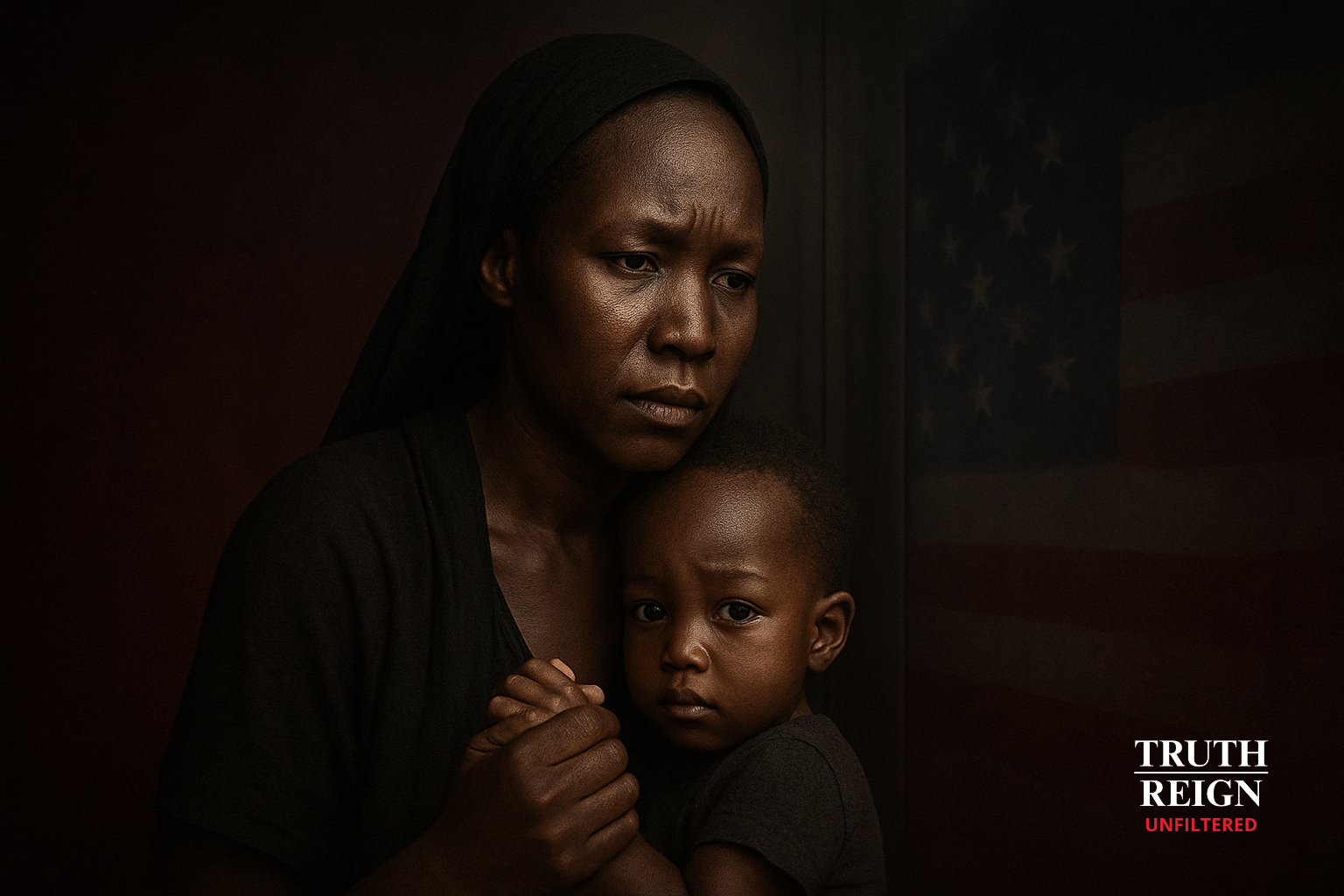
The cruel symmetry of freedom for some — and exile for others.
By: Beautiful Truth | Distorted Truths | November 12, 2025
Sources: Reuters (Maiya Keidan & Susan heavey, 2025), Notice of Termination of Temporary Protected Status for South Sudan (Federal Register, 2025).
TODAY’S TRUTH
SUMMARY
“A 60-day window isn’t mercy; it’s a countdown.”
THE ANNOUNCEMENT THEY CALL POLICY
Let’s start with the truth: The Trump administration’s decision to end Temporary Protected Status (TPS) for South Sudanese nationals isn’t just about paperwork — it’s punishment masked as procedure.
The announcement didn’t come with empathy or explanation — just a notice in the Federal Register, like lives can be reduced to a footnote. Behind that one bureaucratic sentence sits real people who built lives, raised children, paid taxes, and contributed to a country that once promised refuge.
But in America’s political language, policy has become a substitute for compassion. They call it an expiration date, but what it really means is eviction — one that forces families to choose between a country that no longer wants them and a homeland still fighting to survive.
It’s a reminder that legality doesn’t always mean morality — and that what’s written in official ink can still be soaked in injustice.
And when the law starts speaking louder than the conscience, it stops serving the people and starts protecting themselves..
A HUMANITARIAN PROGRAM WITH NO HUMANITY LEFT
TPS was designed for countries suffering from war or disaster. Yet when you end it for a nation still battling hunger and instability, you’re not enforcing order — you’re enforcing indifference in plain sight.
But over time, that bridge became a border.
The same program that once stood for protection now feels like a waiting room for deportation — where every renewal comes with uncertainty and every expiration is treated like an opportunity to push someone out.
When a humanitarian policy forgets the human part, it stops being a lifeline and starts being leverage. Ending it for a nation still battling hunger, corruption, and conflict isn’t order — it’s abandonment.
And indifference, when written into law, doesn’t protect lives — it erases them.
SIXTY DAYS TO LEAVE — OR BE ERASED
And if that wasn’t cruel enough, look at what they’re calling a “grace period.” A 60-day window isn’t mercy; it’s a countdown. You don’t rebuild a country, a home, or a life in two months. You just pack what’s left of your dignity and pray the door doesn’t close too soon.
You cannot transfer a career, a community, or the sense of safety you earned into a passport stamp. You cannot tell a child their home is gone and expect them not to break. People with TPS work, pay taxes, and sew themselves into the fabric of neighborhoods — then are told, without ceremony, that their presence is suddenly illegal. That administrative sentence is a deportation notice in waiting, not a policy discussion.
Preparation means selling furniture at a loss, saying goodbye to neighbors who became family, finding travel funds when payday loans are the only option, and facing the mental weight of returning to a country where the roof over your head might be gone and the danger that chased you here remains. Sixty days doesn’t give safety. It gives panic. It gives trauma. It gives a deadline that quietly erases lives — one form at a time.
And when a government counts down your existence, compassion is not the perpetrator — fear is.
POLITICS IN PLACE OF COMPASSION
This isn’t about improved conditions — it’s about control. Every country Trump stripped of TPS has something in common: black or brown faces, broken systems, and stories America helped create but doesn’t want to own.
Because there is no moral urgency to send people back into danger — only political theater disguised as strength. South Sudan is still unstable. Its government is fragile. Millions remain displaced, and the wounds of civil war haven’t healed. If this were truly about order, compassion would allow time — not a timer.
But this administration doesn’t deal in mercy; it deals in messaging. Extending protection doesn’t win votes, but enforcing deadlines does. That’s why it’s easier to claim “conditions have improved” than to admit the truth: America can afford compassion — it just refuses to spend it on black lives.
Trump’s version of humanitarianism depends on who’s watching.
He’ll extend one hand to nations that serve his image — praising Ukrainian resilience, writing checks for European aid — while using the other to close the door on refugees from African soil. He calls it immigration reform, but what it really is… is selective survival.
Because what’s being protected isn’t national security — it’s political security. And what’s being sent back isn’t just people — it’s America’s promise of decency.
THE SELECTIVE SAVIOR
And that’s where his performance begins. Trump loves to play the part of a liberator — but only when the faces he’s “saving” look like the ones in his reflection. He’s not a humanitarian; he’s a false liberator, a man who drapes himself in the language of freedom while using it as a disguise for control. It’s the White messiah complex on full display — rescuing who he chooses, condemning who he doesn’t.
Because when it’s Ukraine, he’s generous. When it’s South Sudan, he’s gone silent. When the victims are White, he’s a savior. When they’re black, he’s suddenly an economist, cutting budgets and protection in the same breath.
It’s not only hypocrisy — it’s manipulation dressed in mercy. A show of heart with no heartbeat behind it.
And that strategy isn’t accidental — it’s deliberate, divisive, and always draped in patriotism..
AMERICA’S SELECTIVE MERCY
And what’s sickening — this selective compassion isn’t new. The same hands that preach freedom hold the pen that erases it. If compassion depends on the color of a passport, it was never compassion — it was policy.
America loves to market its mercy — to the cameras, to the world, to itself. It will frame empathy like a brand campaign: humanitarian aid wrapped in patriotic colors, sympathy handed out in soundbites, and press conferences dressed up as deliverance. But mercy without consistency isn’t mercy — it’s deception.
For generations, America has chosen who is worthy of rescue and who is easier to forget. It opened its arms to some and built cages for others. It called one group “refugees” and another “migrants,” though both were running from the same kind of fire. It offered asylum to the faces that mirrored its allies, but punishment to the ones that mirrored its sins.
This is the part of the story the slogans never tell — the part where morality bows to money, where race decides rescue, and where policy is just prejudice dressed in protocol. Because true mercy doesn’t measure worth. It doesn’t check skin tone, passport stamps, or polling numbers before offering help.
And the tragedy isn’t just in who America rejects — it’s in how proud it becomes of the rejections. Because the same system that claims to protect humanity often profits from its absence.
THE TRUTH THEY WON’T SAY OUT LOUD
And here’s the bottom line: South Sudan didn’t change. The politics did. And when policy becomes prejudice, protection disappears.
But what they won’t say out loud — what they’ll never put in a press release or a DHS memo — is that this isn’t about safety, resources, or reform. It’s about preserving a version of America that looks generous on paper but ruthless in practice.
They won’t admit that deportation has become performance — a way to feed fear, flex authority, and remind the world who gets to call this country home. They won’t admit that “temporary” protection was never designed to feel permanent for people who don’t fit the preferred picture of America.
And they’ll never say that behind every policy like this one, there’s a quiet calculation: whose suffering is visible, whose story gets sympathy, and whose life is deemed expendable once the cameras turn away.
What they won’t say out loud is that compassion isn’t the weakness they fear — it’s the accountability they avoid. Because to extend mercy is to admit responsibility. And responsibility means facing the damage this country helped cause.
So instead, they rewrite the story. They rename cruelty as policy. They call it immigration reform. They call it national security. But the truth doesn’t vanish just because they’ve learned to whisper it — it waits. And it always finds its way back to the surface.
Because sometimes what they call “procedure” is just power doing what it’s always done — decide who gets to stay human.
“Every clock don’t tell the same time, but the truth always catches up.”
— Beautiful Truth
Thank you all for reading–not just for opinions, but for principle, fairness, and clarity.
— Beautiful Truth
Editorial Disclaimer:
Truth Reign Unfiltered is an independent commentary platform that shines light where others stay quiet. All content published represents protected speech under the First Amendment of the United States Constitution. Opinions expressed are based on publicly available information, cited sources, and personal analysis.
I do not publish to defame—but to inform, challenge, and encourage critical thought. Accountability is not hatred. Truth is not defamation. And silence is never my strategy.